
Adapting to the World's Water Problems
Adapting to the World's Water Problems
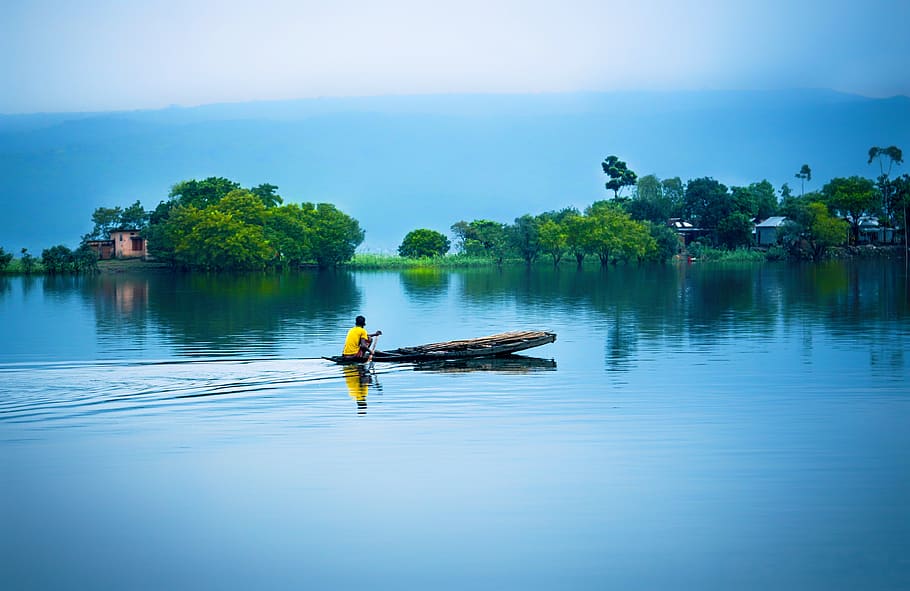
Five doomed explorers in a sub-par submersible aren't the only people who have had to adapt, one way or another, to the pressure of the world's water problems around them lately. Across the globe, imperiled rivers, drought, flooding, and pollution threaten health, national and local economies, and even the continued habitability of populated regions. How societies adapt to these situations speaks not only to their resilience in the face of adversity, it may even signal how well we, as a species, are suited to a rapidly changing environment closing in on us.It's no secret that climate change will add to the world's water problems in increasingly chaotic ways. In 2022, two billion people lacked access to safe drinking water, with half the global population facing water scarcity for at least one month of the year. Factor in a growing population, increased demand for industrial and agricultural use, the modern tendency to pollute water sources as if they weren't necessary for life, and the capitalist manner of rationing scarce resources by cost rather than by need, and it's not hard to see that water (and its relative abundance or lack) will be a major consideration for the foreseeable future.So how are different people and places adapting, and what can we learn from them?Bangladesh, a nation used to coping with watery abundance, has been open to change in ways that the rest of the world would do well to emulate. With little help from the wealthy countries most responsible for climate change, the people of Bangladesh are learning to communicate with each other and people upstream to insure that farmers can harvest their rice crops ahead of potentially devastating floods. They're also using ancient technology to grow vegetable crops on floating beds, so that when the water rises, the plants rise too. The floating farms of Bangladesh and Mexico's chinampa technology could be revived using local materials in flood-prone, watery areas around the world.Floods are among the world's water problems, but so is drought. Some farmers in southeastern Spain's dry Murcia region, however, rely on recycled wastewater to irrigate their crops, a process that not only gives water a second use before returning it to the natural cycle, but also leaves it cleaner than it came in. About 98% of Murcia's waste water is recycled this way (filling 15% of the region's irrigation needs), compared to 9% of the wastewater recycled across Spain and a mere 5% throughout the EU. In a dry future, wasting water should be unconscionable. Toward this end, the Spanish government committed 1.4 billion euros (US$1.5 billion) to building wastewater recycling infrastructure around the country.Texas may be the epicenter of heat right now, but even Canada is feeling the effects of warming and drought. In the prairie land of Alberta, the Texas of Canada, canola farmers are adapting to their slice of the world's water problems through earlier planting (to ensure flowering before the heat of June), leaving more crop stubble and planting trees around their fields to trap winter's snow (so the meltwater can soak into the fields), and breeding (or genetically modifying) drought-resistant seeds, but it's uncler whether anything will help even crops that don't require irrigation to survive in regions increasingly prone to dry conditions.Unless the world abandons industrialism entirely (an option with a non-zero chance of happening), large scale pollution will continue to rank among the world's water problems as well. At Khalifa University in the United Arab Emirates, researchers are pursuing higher technology to solve the problem of water pollution from the textile industry. Inspired by the sticky, protein-based “beards” that help mussels cling to rocks, they created a nanomaterial that combines a polymer with an eco-friendly solvent which, together, clean wastewater from the dyeing process. If it works under real-world conditions, the nanomaterial may have applications for other industries, from pharmaceuticals to mining (although it is worth noting that nanotechnology itself requires industrial infrastructure, and may not be practical everywhere). The world produces an estimated 95 trillion gallons of wastewater annually, equivalent to 41 years of drinking water for a planet's worth of people, so being able to reuse it is key to mitigating shortages.Other attempts at mitigation aren't working as well, but still provide teachable lessons for those willing to learn.In drought-stricken Uruguay, where water was declared a fundamental human right in 2004, the government has turned to desperate measures. Wells are being dug in parks in the Capitol, and the public water utility now mixes salty estuary water with the remaining fresh water supply to keep taps flowing. Those who can afford it have been buying bottled water, while those who can't are stuck with the salty tap water that those with hypertension, kidney problems, or who are pregnant, have been told to avoid.
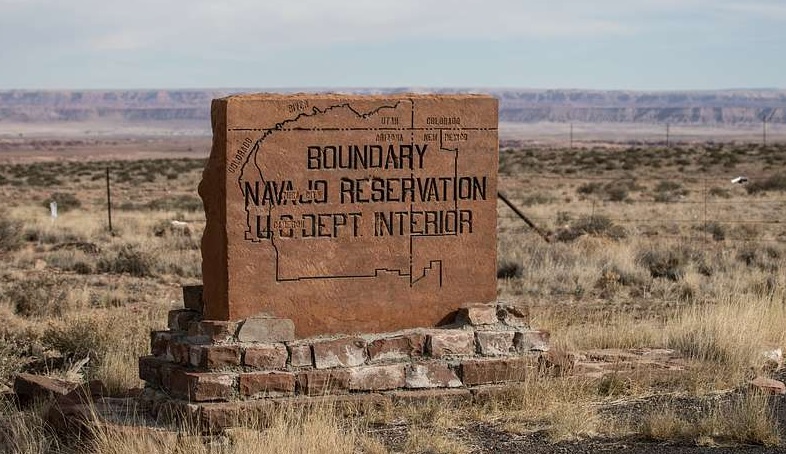 Boundary marker of the Navajo Indian reservation, now called the Navajo Nation, near Cameron, AZ. Public domain image is part of the Carol M. Highsmith Archive, Library of Congress, Prints and Photographs Division. Image courtesy of loc.getarchive.net.
Sources:
Water – at the center of the climate crisis
IPCC Sixth Assessment Report: Fact Sheet - Food and Water (PDF)
Here’s a Look at the Water Crises That Might Be Coming to You Soon
Building a Chinampa
'Every drop counts': Spain's crops thrive on wastewater
One-fifth of water pollution comes from textile dyes. But a shellfish-inspired solution could clean it up
Texas Crops Are Cannibalizing Themselves in Heat Wave
Canadian Prairies Farmers Try to Adapt to a Warming World
‘Drought is on the verge of becoming the next pandemic’
I privatised the water industry – nationalising it again would be a terrible mistake
The U.S. Rivers in Dangerous Decline
Global water reservoir volumes decline despite construction boom: study
The scarcity of water is emerging as a global economic threat. With China and India looking the most at risk
In a scathing dissent, Neil Gorsuch compared the Navajo Nation's plight to the experience of 'any American who has spent time at the Department of Motor Vehicles'
Supreme Court Keeps Navajo Nation Waiting for Water
3M to pay $10 billion to clean up 'forever chemicals.' Critics say that's not enough
Industry knew about risks of PFAS 'forever chemicals' for decades before push to restrict them, study says
'Do not eat': High levels of toxic ‘forever chemicals’ found in deer and fish
It’s literally raining PFAS around the Great Lakes, say researchers
Putting salt in tap water and drilling wells in parks: one country’s desperate quest to avoid running dry
Earth’s axis has shifted. Why using groundwater is to blame
New Mexico lawmakers question fallowing as way to reduce water use along the Rio Grande
The Hidden Underground Lake in the Center of the U.S. Threatening Farming
Arizona is running out of water. Big Tech data centers are partly to blame.
Our bottled water habit stands in the way of universal clean drinking water
Iowa meteorologist resigns after death threats over climate crisis coverage

About Dawn Allen
Dawn Allen is a freelance writer and editor who is passionate about sustainability, political economy, gardening, traditional craftwork, and simple living. She and her husband are currently renovating a rural homestead in southeastern Michigan.