Contract Negotiation: Important Things to Know

Contract Negotiation: Important Things to Know
Contracts play an important role in several transactions and deals between businesses, businesses and customers, real estate deals, prenuptial, or employment. Regardless of your industry, you might need to get into a contract at some point. Negotiating during the contract process is normal. However, most people don't know how to negotiate, the process, and the outcomes to anticipate.The primary goal of negotiating a contract goes beyond reaching a mutual agreement. Contract negotiation allows you to improve the economic status of your relationship while cautioning your business from possible risks. Unfortunately, most companies still depend on outdated contract negotiation processes that can derail them from the main goals.Below is a guide on contract negotiation and how a transparent and unified platform simplifies negotiations.What is Contract Negotiation?Contract negotiation is a process where two or more contracting parties debate and deliberate over various contractual terms. The main goal of negotiating contracts is to ensure that all parties are satisfied with the duties, responsibilities, benefits, and risks.For instance, when negotiating with your contract vendors, you should advance your business' interests by negotiating for lenient termination terms. On the other hand, vendors also hope to achieve the opposite to favor their deals. By negotiating such terms, both parties have to compromise and agree on conditions that favor all parties equally.Why is Contract Negotiation Important?Contracts are legally binding agreements. Before getting into a contract, participating parties should ensure that the contract is mutually beneficial and doesn't favor the other party at their expense. Contract negotiation typically ensures that the contract is mutually beneficial.Negotiation also eliminates confusion and conflicts by ensuring that all parties review, discuss, and agree on the contractual terms. If correctly done, contract negotiation enables parties to establish terms that favor them, instead of one party having the bargaining power or creating one-sided terms in the contract and possible breaches.Contract negotiation is an important step in a contract lifecycle that determines whether the contract will be signed or not.Contract Negotiation ApproachesContract negotiation falls in either of these two categories;1. Distributive NegotiationDistributive or zero-sum negotiation is an approach where one party succeeds only if the other loses, and the discussion revolves around one issue. For instance, suppose a company wants the services of an IT vendor. In the contract, the company wants to gain maximum IT services for the least price possible.Similarly, the IT vendor aims to provide the least possible IT resources for the best price. Both parties' desire to get the best from the deal requires a distributive negotiation approach. To succeed in distributive contract negotiation:
Be persistent
Front the first offer – making the first offer swings the bargaining to your favor
Don't disclose your minimum acceptable outcome
Have a principled approach
Discuss your business interests and needs openly
Be ready to bargain and compromise for other parties
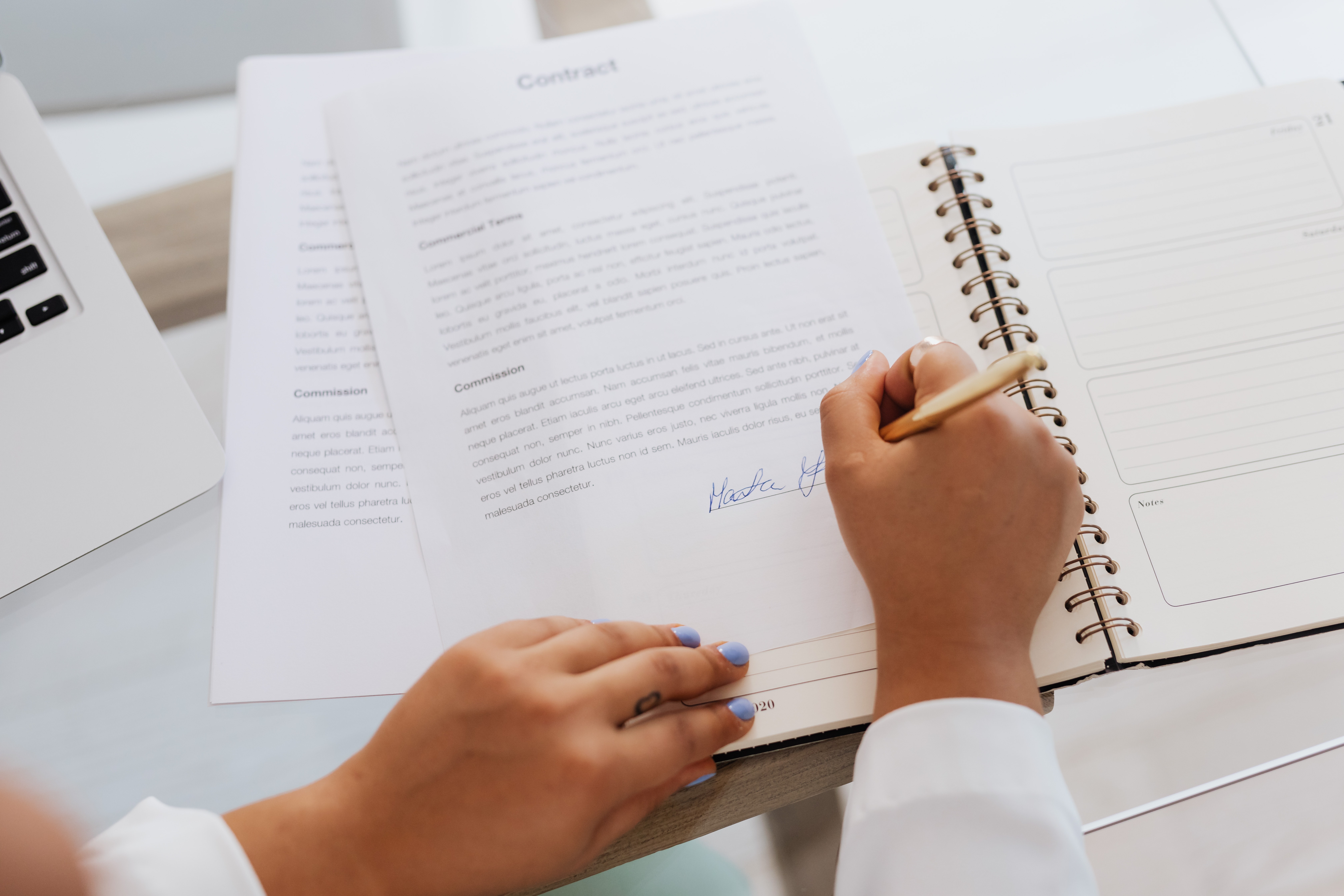 Woman signing contract; Photo by Karolina Grabowska from Pexels.com.
About Henry Martinez
Henry Martinez is a legal practitioner and advisor. He conducts webinars and offers consultations to help people find justice. He also writes blog posts and guest posts on legal-related topics. Henry loves to enjoy his free time scuba diving and snorkeling with his family and friends.