
Epic Reuse Avoids Eco Abuse

Epic Reuse Avoids Eco Abuse
With supply chains in disarray and prices driven up by natural disasters, war, resource depletion, planned obsolescence and the high cost of fuel, there's no better time to engage in some creative and epic reuse of materials that already had a useful life, but are more than ready for a re-tread afterlife.Necessity being the mother of invention, Ukrainians have more than a little incentive right now to get clever with whatever they can put together and make functional again.Luckily, Russian invaders keep dropping secondhand supplies on them that can occasionally be pressed back into service with a little elbow grease and the right size ammo. The 93rd Mechanized Brigade, which has disabled more Russian tanks than can be easily repaired, told the Washington Post that the five Russian tanks they've refurbished so far are some of the newest equipment in their arsenal.What can you do with a British NLAW (a one-shot, shoulder launched anti-tank missile) once it's all used up? Sweaty Ukrainian fighters found another epic reuse opportunity by turning empty NLAW launchers into field showers. Glory and cleanliness to Ukraine!The coal industry isn't an especially intuitive place to look for ecological initiatives, yet from the literal ashes of a dying industry springs some hope for a better future.Courtesy of a $5 million grant from the U.S. Department of Energy, researchers at Ohio University in Athens have figured out how to separate valuable carbon from coal waste products and use it to make building materials that are anticipated to be cheaper than comparable wood-based products, and with fewer emissions too (if you don't count the original coal's environmental cost, one assumes). Using legacy coal waste, a liability plentiful in Appalachia, to create a product in high demand across industries from construction to aerospace, is an absolute best-case scenario for the environment and the region.Defunct coal-burning power plants may also have a useful second life generating energy from renewables. Right now, there are over 600 decommissioned coal plants in the United States. They're already connected to the power grid (and, frankly, already ugly), making them the easy option when locating a new power project. So far, Illinois is leading the way with epic reuse of dead coal plants, giving nine of them a clean(er) afterlife as solar farms and battery banks, while northeastern coastal states have turned their coal-burning properties into wind farms to harvest that cool ocean breeze.Even before the current shortages, upcycling edible by-products and waste from the food industry was in focus as a socially and ecologically sound growth opportunity. Take banana peels, for example. Previously, their highest use seemed to be in the compost pile, providing gardens across the globe with a useful burst of potassium and magnesium pulled from hot, tropical soils. Who knew that they would also be tasty in a sandwich? That's the idea at the heart of ventures like Banana Business, a Dutch firm turning out “pulled peels,” a meat alternative marinated in proprietary spices and turned into fillings for wraps and salads.People have spent the entire industrial era burning through virgin resources and turning them into pools of pollution. If you want to be a real hero, invert the paradigm and invent your way into epic reuse of waste to make the products that people need. Trash is the perfect input: it's plentiful, cheap, and if you ask for it, people might give it to you. Better yet, they might pay you real money to take it away!In Kenya, Mahamud Omari took newspapers out of the waste stream and started turning them into pencils, giving some of them to children whose families can't afford school supplies. His pencil factory also pays workers three times the local minimum wage. The paper will still make it to the landfill as pencil shavings eventually, but along the way, it may well help a kid learn to read and write, while helping another family afford food and shelter.
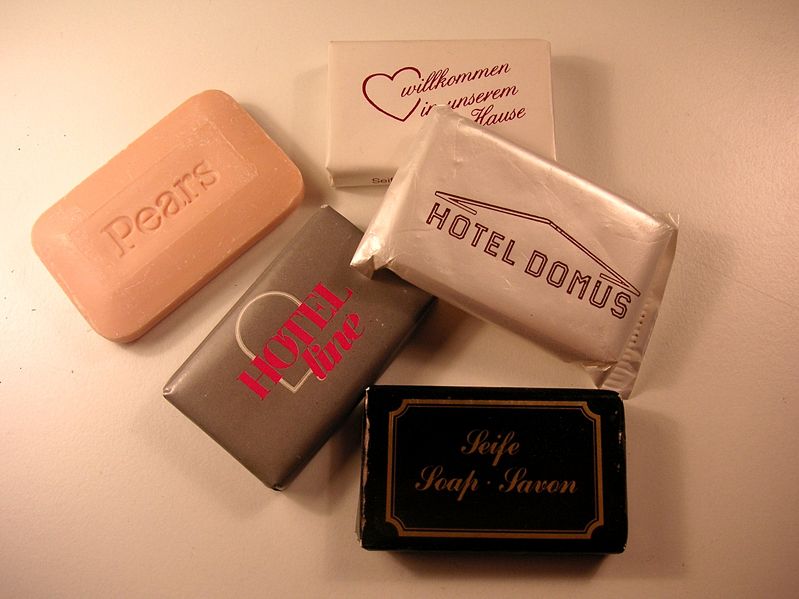 Hotel soaps. Photo by Holger.Ellgaard, courtesy of Wikimedia Commons. CC BY-SA 3.0
Sources:
The looming copper crunch and why recycling can’t fix it
Some Epson Printers Are Programmed to Stop Working After a Certain Amount of Use
Ukrainians recycle Russian tanks to use on the battlefield
Defense of Ukraine on Twitter
From abandoned mines to store shelves: OU transforms coal waste into renewable materials
In an Unexpected Twist, Old Coal Plants are Being Repurposed to Generate Clean Energy
Growing the Upcycled Food Economy
Banana Peel Cuisine Is The Latest Plant Based Trend
Pencils made from old newspapers could reduce pollution
The surprising afterlife of used hotel soap
Meet the girl turning trash into treasure in Malaysia
Chile’s desert dumping ground for fast fashion leftovers
Inside a Chilean Factory Turning Old Clothes Into High-Quality Eco-Yarn
From high notes to high seas: How this Surrey man turned 3 pianos into a canoe

About Dawn Allen
Dawn Allen is a freelance writer and editor who is passionate about sustainability, political economy, gardening, traditional craftwork, and simple living. She and her husband are currently renovating a rural homestead in southeastern Michigan.