
How Hourly Salary Calculations Can Protect Your Business Legally

How Hourly Salary Calculations Can Protect Your Business Legally
In today's highly regulated business field, ensuring accurate hourly salary calculations is not just a financial obligation - it's a critical legal safeguard. Wage and hour lawsuits cost U.S. employers $3.62 billion in settlements in 2021 alone. Miscalculations or non-compliance with wage and hour laws can expose businesses to severe consequences, including hefty fines, penalties, and costly legal battles. Protecting your business from these risks begins with an understanding of the intricate web of federal and state laws governing hourly wages. This blog post will delve into the businesses can take to ensure precise hourly salary calculations, mitigating the risk of non-compliance and safeguarding their operations from potential legal pitfalls.1. Understanding Legal Requirements for Hourly WagesAccurate hourly salary calculations are crucial for legally protecting your business by ensuring compliance with labor laws and regulations. Utilizing an hourly salary calculator can help maintain transparency and accuracy in wage determinations, preventing potential disputes over employee pay. This tool aids in calculating overtime, deductions, and benefits correctly, thereby safeguarding the business from costly legal issues such as wage theft claims or violations.The Fair Labor Standards Act (FLSA) is the cornerstone of federal wage and hour laws, setting the national minimum wage and overtime pay requirements. However, many states have their labor laws that often supersede the federal standards, making compliance a nuanced endeavor for businesses operating across multiple jurisdictions. For example:
The federal minimum wage state is currently $7.25 per hour in the U.S., but states like California and New York have higher minimum wages at $15.50 and $14.20 per hour, respectively.
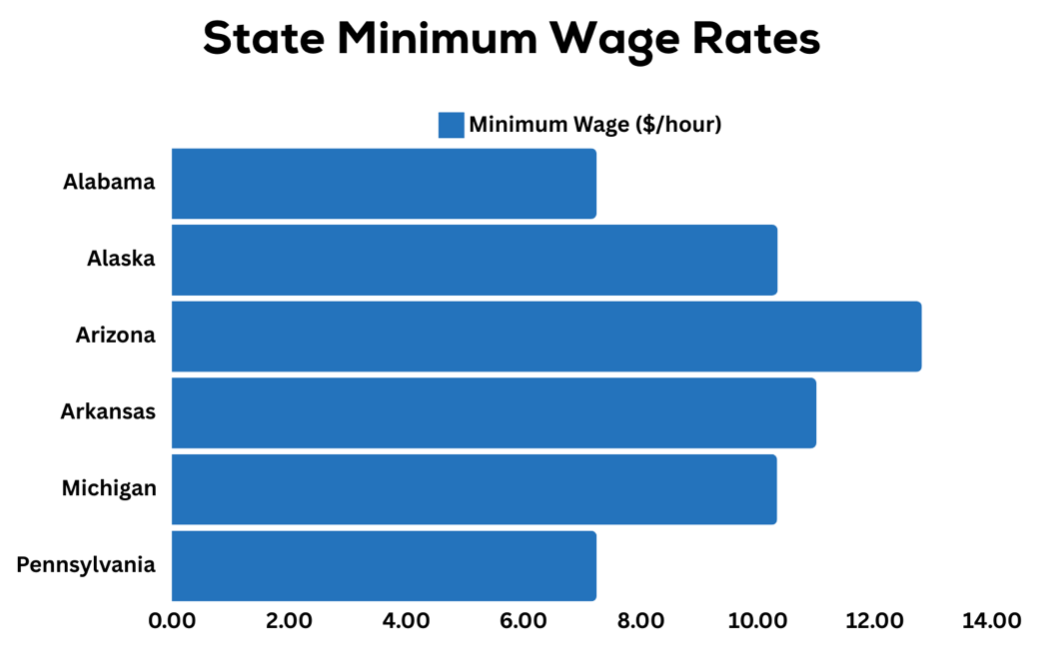 State Minimum Wage Rates; source U.S. Department of Labor.
Non-compliance with the FLSA can result in penalties of up to $2,014 per violation, showcasing the high stakes involved in accurate hourly wage calculations.
Investigate the root cause: Conduct a thorough investigation to understand the source of the discrepancy, whether it was a one-off incident or a systemic issue, and the extent of the impact.
Correct underpayments promptly: If the discrepancy results in an underpayment of wages, businesses should calculate and issue back pay to affected employees as soon as possible, including any applicable interest or penalties required by law.
Adjust payroll practices: Based on the findings, update payroll processes, policies, and employee training to prevent similar discrepancies from occurring in the future.
Communicate transparently: Maintain open and transparent communication with affected employees, explaining the issue, the corrective actions taken, and any necessary changes to payroll practices.
Seek legal counsel: Consult with experienced labor and employment attorneys to ensure compliance with applicable laws and to develop a proactive strategy for addressing potential claims or legal ramifications.
Misclassification of employees: Incorrectly classifying employees as exempt from overtime rules can lead to underpayment and legal issues.
Failure to track all hours worked: Not accurately capturing all hours worked, including breaks, travel time, and off-the-clock work, can result in underpayment and wage theft claims.
Incorrect overtime calculations: Miscalculating overtime rates by failing to account for applicable laws, such as paying time-and-a-half for all overtime hours instead of using the correct weighted average or regular rate calculations.
Improper deductions: Making unlawful deductions from employee paychecks such as deductions for uniforms or tools without proper consent, can constitute wage theft.
Failure to comply with state-specific laws: Not accounting for state-specific minimum wage rates, meal and rest break requirements, or other labor laws can lead to violations and penalties.
Large businesses or those operating in multiple states: Conduct payroll audits at least annually, with targeted spot checks and reviews occurring more frequently (e.g., quarterly or bi-annually).
Small to medium-sized businesses: Perform full payroll audits annually, accompanied by regular internal reviews and checks to ensure ongoing compliance.
High-risk industries: Businesses in industries with a higher risk of wage and hour violations, such as hospitality, retail, or construction, may require more frequent audits (e.g., bi-annually or quarterly).
Organizations like the American Payroll Association and the Society for Human Resource Management provide valuable guidance, updates, and best practices.
Federal and state labor departments often offer free resources, webinars, and guidance on wage and hour laws.
Consulting with experienced labor and employment attorneys can provide tailored advice and ensure compliance with the latest legal developments.
About Daniel Martin
Dan has hands-on experience in digital marketing since 2007. He has been building teams and coaching others to foster innovation and solve real-time problems. In his previous work experiences, he has developed expertise in digital marketing, e-commerce, and social media. When he's not working, Dan enjoys photography and traveling. LinkedIn