A group of Louisiana families is contesting a recently-passed law requiring that copies of the Ten Commandments be displayed in public-school classrooms throughout the state. The lawsuit names dozens of plaintiffs: parents, priests, and ministers, all of whom believe that House Bill 71 poses a fundamental threat to their right to worship free from interference.The families are receiving legal counsel and support from the American Civil Liberties Union Foundation, as well as Americans United for Separation of Church and State, the Freedom From Religion Foundation, and the private New York-based law firm Simpson, Thatcher & Bartlett.Rev. Jeff Simms, a Presbyterian pastor and named plaintiff, suggested that the state’s decision to mandate the display of the Ten Commandments sends an implicit message that—even among Christians—the beliefs of certain sects and denominations better and more accurately reflect scripture than others.
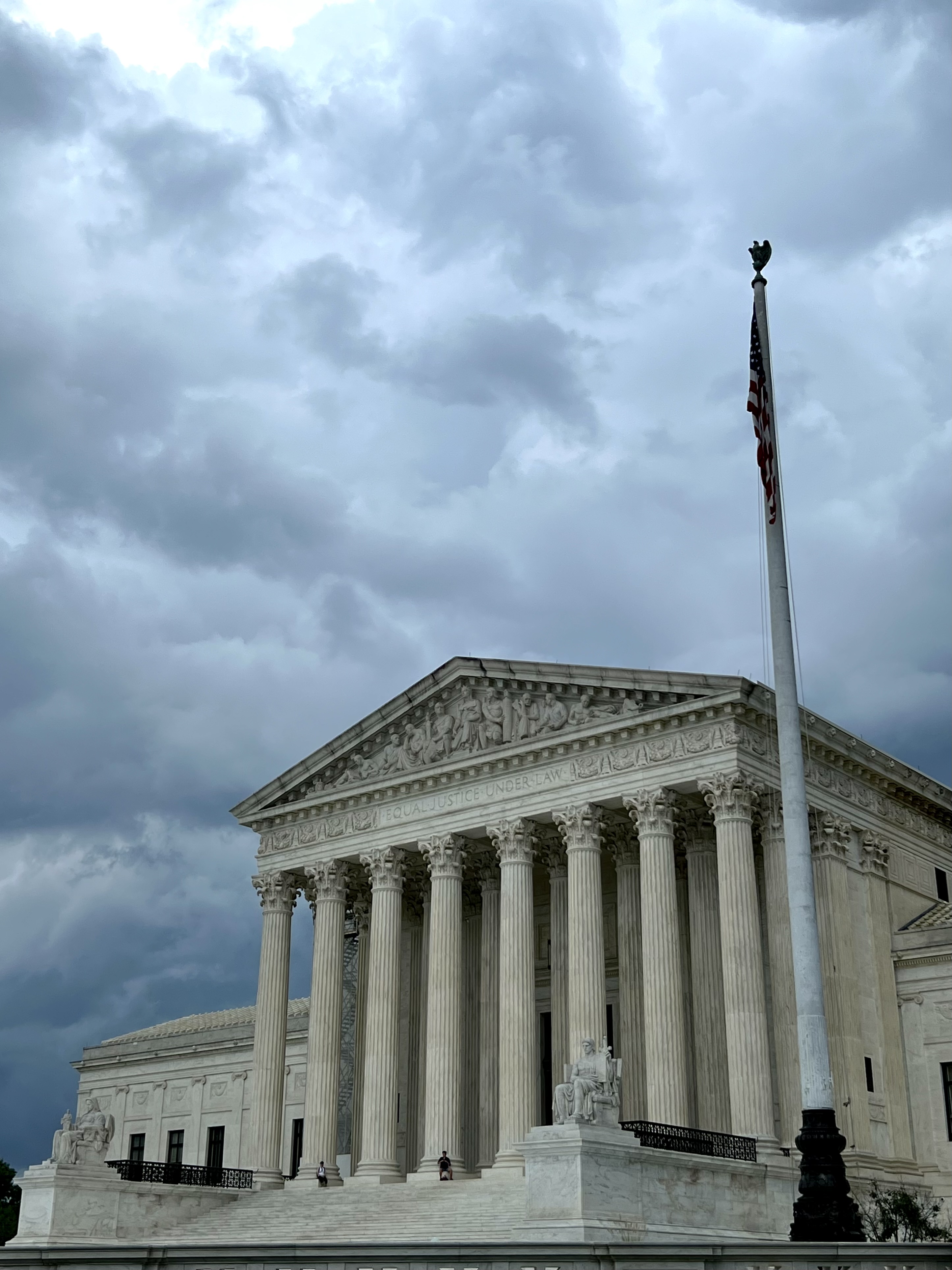 The Supreme Court building in Washington, D.C. Image by Ryan J. Farrick.
The families behind the complaint have
shared hopes that their lawsuit could lead Louisiana to abandon—by choice, or by writ—a policy they allege is unquestionably exclusionary.“Politicians have absolutely no business forcing their religious beliefs on my kids or any [other] kids, or attempting to indoctrinate them with what they think is the right version of a particular piece of religious text,” said Joshua Herlands, a plaintiff who is Jewish and whose two children attend New Orleans-area public schools.But Louisiana Gov. Jeff Landry and state Attorney General Elizabeth Murrill have reaffirmed their confidence in the law’s constitutionality—and have pledged to defend it from its detractors.“It seems the ACLU only selectively cares about the First Amendment,” Murrill said in a statement. “It doesn’t care when the Biden administration censors speech or arrests pro-life protesters, but apparently it will fight to prevent posters that discuss our own legal history.”In the not-so-distant past, these arguments would have seemed likely to end with a decision preventing the state from enforcing its new Commandment requirements. However, different courts have not always agreed on the extent or limits of the separation between church and state. And today’s Court—with a conservative chief justice, three Trump appointees, and outspoken originalist Clarence Thomas—may well treat Louisiana’s arguments with less skepticism than its predecessors.Thomas, in particular, has expressed few reservations in attacking the foundations of separation doctrine, which he believes predicated upon a gross
misinterpretation of the Founders’ original intent. For Thomas, the Establishment Clause is
but “a federalism provision” prohibiting Congress from directing the religious dictate of individual states—not a bulwark protecting individual people from the dictatorship of a state’s preferred religious practice.Louisiana’s legislation, then, could easily have been designed to leverage the potential consequences of a legal challenge that the bill’s sponsor and proponents would have been foolish not to expect.Because, if the district court rules against the plaintiff families—and attempts to appeal fall flat—then the Commandments still stand. And, if the case makes its way to Washington, its outcome could be determined by sympathetic justices of a Court that has shown itself very willing to reconsider and rebuke longstanding precedent.