
What Can We Do With the Office Buildings?
What Can We Do With the Office Buildings?
With a majority of Americans now believing that the pandemic is behind us (despite an excess death rate that says otherwise), daily life is steadily approaching a new normal. People are returning to restaurants and movie theaters, unafraid of inhaling the public's anonymously launched respiratory droplets. This is good news for many businesses and shareholders, but one sector that isn't roaring back with nearly so much enthusiasm is office real estate. In city centers across the U.S., office buildings remain at partial capacity, losing both economic and social value.Emergency measures that allowed us to work from home during the pandemic proved that remote work isn't only possible for more people than we were led to believe, it also taught us just how satisfying it is to skip the commute, take a walk at lunch, toss a load of laundry in before that Zoom meeting, and have more face time with the people we love. As a result, the push for remote (or at least hybrid) work is an enduring feature of the new normal, at least for people with higher wages or educational attainment.Despite management's deep desire to babysit employees, making sure they've got fingers on keyboards and not taking a minute too long in the bathroom, the opportunity to work remotely has become a critically important benefit for many job seekers. So much so, that companies offering flexible work schedules are hiring at roughly twice the rate as those that don't. In the second quarter of 2023, 51% of companies offered some variety of remote work, up from 43% in Q1.Companies without flexible work options have had a harder time attracting talent. Perhaps it's all that “extra collaboration” going on in offices that results in people having to take more work home at the end of the day just to get it all done. (Spoiler: That's not the kind of “work from home” that people are into anymore.)Remote work may be what employees crave, but won't someone think of the office buildings?The number of remote workers phoning it in to employers in cities with vast business districts, like San Francisco and New York, is so high that it's driving down the value of commercial real estate. Occupancy rates are about half of what they were before the pandemic, and while that would seem like savings for companies that can condense their space and sell off a significant fraction of their holdings (or simply move out at the end of their leases), it doesn't work like that in a market where everyone is doing the same thing.That causes downstream problems for those whose livelihoods depend upon demand for office buildings. Of course there are the coffeeshops, corner stores, and sandwich slingers falling into precarity, but we can also expect more bank foreclosures, lost tax revenue, and desperate landlords (try not to feel too sad about those). San Francisco employers have so many remote workers that the city lost $484 million in tax revenue in 2021. Between home-based work situations and tech company layoffs in recent years, San Francisco area office buildings are cluttering the market, but since they're not yet dropping to fire sale prices, buyers aren't exactly lining up.With about $24.8 billion worth of distressed office real estate across the United States and banks nervous about their loan portfolios, one would think that the perfect solution would be to turn what we don't need – big city offices – into what we do need, such as affordable housing. Developers are taking stabs at this, because it's an obvious opportunity to make a buck, but it comes with a load of problems.For starters, it's not as simple as one might think to convert office buildings into residential apartments.
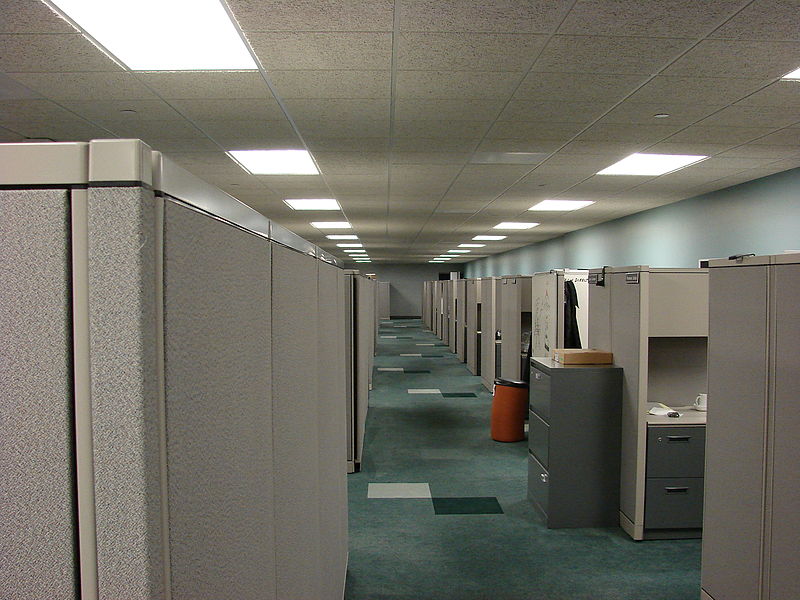 It's hard to turn large, windowless spaces into residential dwellings. Photo by Loadmaster (David R. Tribble), courtesy of Wikimedia Commons. CC BY-SA 3.0
Sources:
America's COVID-free summer mindset
The Pandemic Really Is Over, No Seriously, We Mean It This Time
Looks Like Someone's Been Moving The Pandemic Goal Post
Family Relationships Under Work From Home: Exploring the Role of Adaptive Processes
Who Gets the Option to Work From Home? There's a Huge Disparity Tied to Income
The latest on hybrid work: Who is WFH and who isn’t
Is there such a thing as too much collaboration? The push to get workers back in the office could come with big risks
Surprise, surprise: Companies offering remote work are growing faster than those that don’t
Companies Requiring Full-Time In-Office Are Struggling to Recruit New Employees
Commercial real estate may not recover until 2040, with low-occupancy, high-cost cities like New York and San Francisco hit hardest
City Report Says Remote Work Cost SF $484 Million In Tax Revenue In 2021
No takers on San Francisco’s big tech buildings for sale
Distressed US Offices Jump to $24.8 Billion, More Than Malls
As Remote Work Becomes Permanent, Can Manhattan Adapt?
Office real estate values are moving down so fast that banking giants like Wells Fargo are already bracing for losses
What It Takes to Convert a Multi-Million Dollar Office Into Housing
Why the Dream of Turning Empty Offices Into Housing Is a Bust
‘Soul-crushing’: converted Bay Area office apartment fail goes viral
Empty Office Buildings Are Being Turned Into Vertical Farms
Indoor vertical farms fill empty office space as the industry grows
Don’t Fret About Empty Office Space—Repurpose It
What To Do With All Those Vacant Offices? Startups See Space For Everything From ‘Learning Pods’ To ‘Microgyms’
6 Ways to Transform Your Empty Office Space to Make a Profit
Alarm as fastest growing US cities risk becoming unlivable from climate crisis
Spolia - Recycling the Past
Can a City be Sustainable?

About Dawn Allen
Dawn Allen is a freelance writer and editor who is passionate about sustainability, political economy, gardening, traditional craftwork, and simple living. She and her husband are currently renovating a rural homestead in southeastern Michigan.