
Who Pays for Biden's Infrastructure Bill?
Who Pays for Biden's Infrastructure Bill?
History doesn't repeat, but it certainly rhymes, and here we are again with a President pushing a giant infrastructure bill. Because Joe Biden has a “D” by his name, the same Republicans that praised former President Trump's infrastructure happytalk will say we don't need and can't afford it, just like they did under Obama. We'll have arguments where the GOP is uncomfortable with the suggestion that water pipes could ever really be considered infrastructure, while the Democrats think childcare counts. They can agree on one thing, though, and that's to ignore the infrastructure trap.It's a story as old as civilization. As a society grows, problems develop, like needing more water to irrigate more crops to feed more people. Solutions, such as aqueducts or pipes, are costly, but the benefit they provide is such a jump in productivity that the cost is more than justified. Unfortunately, over time, the structures decay, and people either have to continue paying for maintenance while receiving no net increase in productivity, or to abandon the structures if they can't afford to maintain it anymore or prefer to invest their resources elsewhere. Diminishing returns mean that eventually, it all costs too much to maintain, and that's one way a society collapses.Biden's infrastructure bill, “The American Jobs Plan,” certainly addresses the traditional road and bridge repairs that are needed after years of budget cuts and austerity measures. While Republicans would prefer to stop there, Biden's plan also focuses on other needs in a modern economy, such as providing high-speed internet to all Americans, upgrading hospitals, and building affordable housing. Texans should certainly understand why an updated electrical grid would be a good idea, and Flint isn't the only American city that needs to replace lead pipes. Plus, it's amusing to see Republicans reflexively recoil from Biden's plan to encourage cities to rescind some zoning regulations, as if they suddenly like “big government” again.
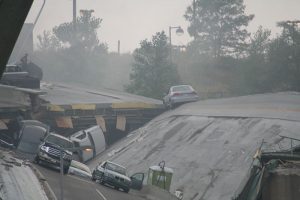 Cars are turned over and pieces of highway and concrete are everywhere after the I-35W bridge collapsed in Minneapolis, Minnesota (USA) on August 1, 2007. Photo by Tony Webster, courtesy of Wikimedia Commons. CC BY 3.0
Sources:
FACT SHEET: The American Jobs Plan
Biden Plan Spurs Fight Over What ‘Infrastructure’ Really Means
Biden’s innovative idea for tackling skyrocketing housing prices
Biden’s infrastructure tax hike worries some Democrats about impact on wealthy voters
About Dawn Allen
Dawn Allen is a freelance writer and editor who is passionate about sustainability, political economy, gardening, traditional craftwork, and simple living. She and her husband are currently renovating a rural homestead in southeastern Michigan.